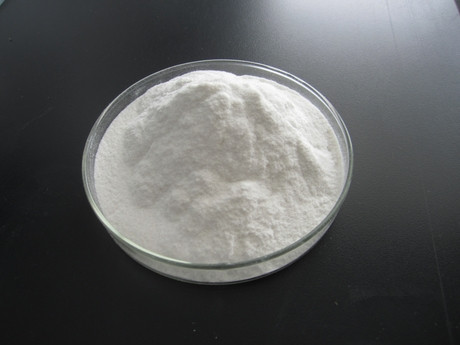
Microcrystalline cellulose (MCC) has the formula (C6H10O5)n, the same as cellulose. It is purified, partially depolymerised cellulose: a white, free-flowing powder (CAS 9004-34-6) with a degree of polymerisation typically below 400. It is one of the most widely used fillers and binders in tablets and capsules, and in food it is the additive E460(i).
What the formula (C6H10O5)n means
C6H10O5 is one anhydroglucose unit, the building block of every cellulose chain. The “n” is the number of units joined in a chain. Natural cellulose in wood pulp has very long chains. MCC is made by treating alpha-cellulose from fibrous plant material with mineral acid. The acid removes the less ordered (amorphous) regions and leaves short, crystalline segments, so MCC has the same formula as cellulose but a much lower “n” (typically below 400) and higher crystallinity.
| Cellulose (wood pulp) | Microcrystalline cellulose | |
|---|---|---|
| Formula | (C6H10O5)n | (C6H10O5)n |
| Chain length | Long | Short (DP typically below 400) |
| How it is made | Pulping of wood or cotton | Acid hydrolysis of alpha-cellulose, then washing and drying |
| Form | Fibres | Fine, free-flowing powder |
| Main uses | Paper, textiles | Tablet filler and binder, food additive E460(i) |
Key properties
Typical values from our MCC technical data sheet (GAC-MCC):
| Parameter | Typical value |
|---|---|
| Appearance | White powder |
| Assay | 97–102% |
| pH | 5.9–6.6 |
| Water-insoluble substances | 2% max |
| Residue on ignition | 0.2% max |
| Heavy metals | 10 ppm max |
| Arsenic | 2 ppm max |
| Conductivity | NMT 75 μS/cm |
| Starch | Negative |
Values are typical and for reference; each lot ships with its COA.
Where MCC is used
- Tablets and capsules: diluent, binder, adsorbent and disintegrant. MCC works in both wet granulation and direct compression and gives hard tablets that still break up quickly.
- Food: bulking agent, anti-caking agent, emulsion and foam stabiliser and carrier for nutritional supplements. See MCC in food (E460).
- Dietary-fibre products: a functional fibre base in health foods.
MCC grades at a glance
| Grade | Average particle size | Typical use |
|---|---|---|
| PH101 | 50 μm | Standard grade for wet granulation and direct compression |
| PH102 | 100 μm | Better flow for direct compression |
| PH103 / PH113 | 50 μm | As PH101 with reduced moisture, for moisture-sensitive actives |
| PH105 | 50 μm (finest) | Most compressible PH grade |
| PH112 | 100 μm | As PH102 with much reduced moisture |
| PH200 | 250 μm | Highest flow, helps content uniformity |
| PH301 | 50 μm | Denser than PH101, better flow and weight uniformity |
Full specifications and documents are on the microcrystalline cellulose product page. For a deeper comparison, read MCC grades PH101, PH102, PH200 and more and how MCC is made.
Is microcrystalline cellulose safe?
MCC is chemically inert. It is not broken down or absorbed during digestion, so it passes through as dietary fibre; very large amounts can have a laxative effect. The US Select Committee on GRAS Substances regarded it as generally recognised as safe at normal levels of use, and it is listed as a food additive (E460(i)) in the EU. Pharmaceutical grades are supplied to the CP, USP or BP pharmacopoeia.
FAQ
What is the chemical formula of microcrystalline cellulose?
(C6H10O5)n, the same as cellulose. Each C6H10O5 unit is one anhydroglucose ring; in MCC the chains are shorter (degree of polymerisation typically below 400).
What is the CAS number of microcrystalline cellulose?
CAS 9004-34-6.
Is microcrystalline cellulose the same as cellulose?
Chemically yes: same formula and the same glucose units. MCC is cellulose that has been partly hydrolysed with acid, leaving short, crystalline particles that compress and flow well.
What is microcrystalline cellulose used for in tablets?
As a filler (diluent), binder and disintegrant, in both wet granulation and direct compression. PH101 is the standard grade; PH102 and PH200 flow better for direct compression.
Is microcrystalline cellulose used in food?
Yes, as E460(i): an anti-caking and bulking agent, a stabiliser for emulsions and foams, and a carrier for nutritional supplements.